African Wild Dogs are one of my favourite animals. As well as their outstanding beauty, they hunt with incredible and formidable efficiency. Chasing their prey over great distances to the point of exhaustion, they work together and strategically take turns in leading the pack so as not to tire themselves. As such, they maintain large territories and have some of the greatest area requirements of African fauna. Consequently, they are also currently one of the most endangered, with populations continuing to decline through habitat degradation and loss, persecution, trophy hunting and disease. I’ve had the fortune of two amazing encounters with them, both involving small miracles and inspiring resilience.
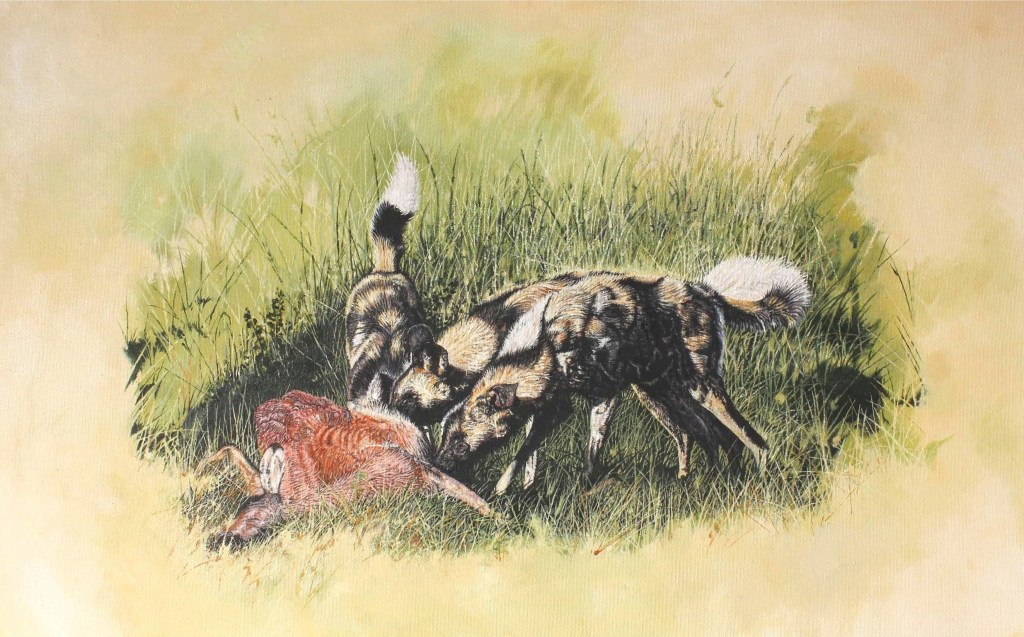
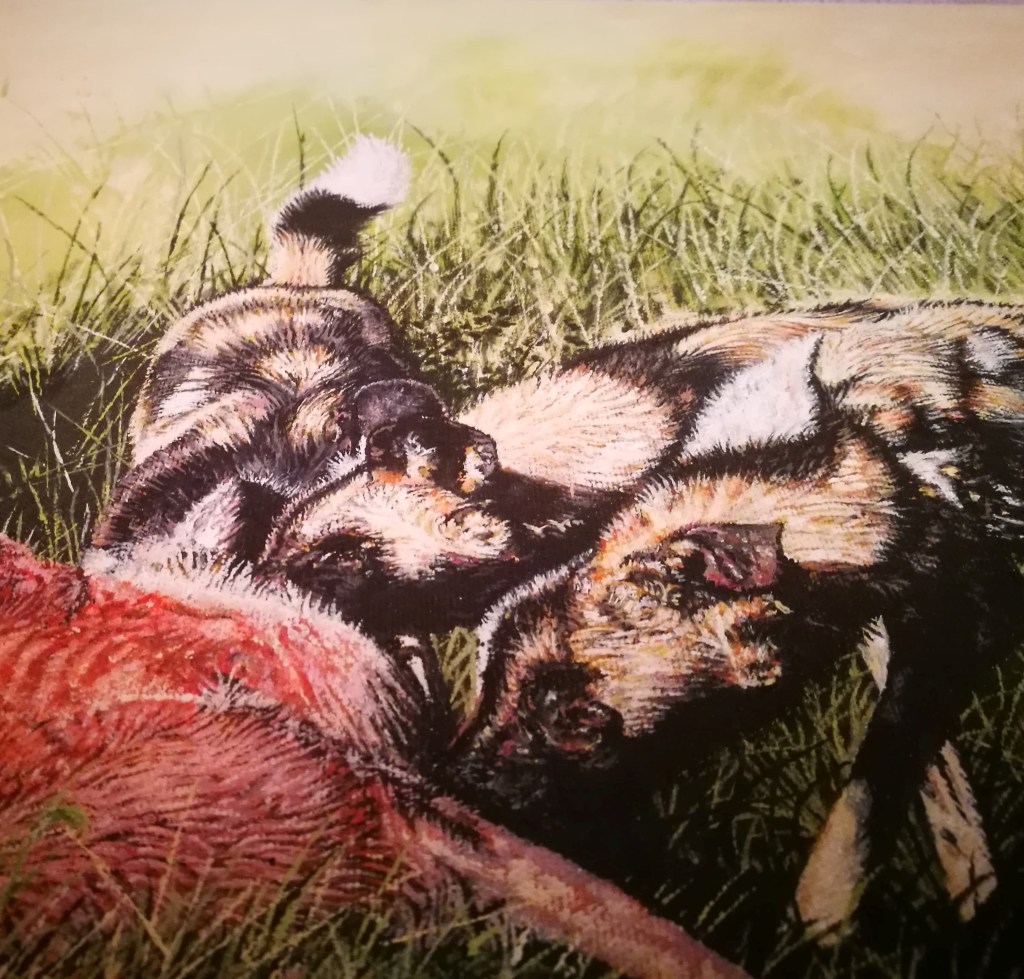
The three I’ve painted here were sisters being temporarily kept at a reserve I visited in South Africa back in 2017 as part of an ongoing metapopulation programme. They were related to all of the remaining males of their original pack and thus in need of a new home and new family in which to breed. Before release, they are first introduced into an enclosure called a boma to allow them and the resident individuals to bond and grow accustomed to one another. Afterwards, they will then quickly dehabituate to their captive lifestyle and resume hunting again.
The sisters were originally supposed to be released to northern Kruger, but sadly the pack there rejected them and managed to attack them through the fence of their boma. One was badly injured, losing an eye, an ear and an entire part of her face in the process… but she was a fighter and with the help of her amazing vets survived. We volunteering at the reserve ensured that they were well fed and looked after in the following months until release onto a new, larger, community reserve was secured.
I also had an incredibly moving encounter with some wild dogs early 2019 in Kenya. Whilst there we met Dedan who had been managing the county’s amazing conservation project researching and looking after the local population since 2001. In Kenya, the relative lack of fences compared to other parts of Africa and the interspersion of people and wildlife has meant that wild dogs come into close proximity and contact with communities and farmers, inciting conflict and persecution. The project’s conservation work includes research and monitoring of the population through satellite tracking, as well as engaging and educating farmers and landowners on the best means to mitigate conflict and protect their livestock for the benefit of both the dogs and themselves and allow them to co-exist.
One of the biggest issues they face, however, is the spread of disease. With growing settlement and surges in immigration, the number of domestic dogs has increased in the region, used as pets or for herding livestock. Free to roam in and out of conservancies, they live in sympatry with the wild dog population and are a reservoir for zoonotic diseases such as rabies, with disastrous consequences for both people and wildlife. Rabies in particular kills thousands of people a year across Kenya, 98% of which is attributed to domestic dogs.
Following focused efforts and years of hard work, the team oversaw an eight-fold increase in the county’s wild dog population to become the largest in all of Kenya. There is also an ongoing campaign to vaccinate domestic dogs against rabies far and wide in hope of locally eradicating the disease. Tragically, however, in 2017 there was a catastrophic outbreak of canine distemper which decimated the population and all 15 packs died. I couldn’t imagine how awful that crushing blow must have felt to Dedan and the rest of the team. Then, by a miracle, a single surviving female was spotted in 2018. By yet another miracle she was joined by two male nomads to form a group from which an entirely new pack have established and is now thriving.
We waited patiently for well over an hour as Dedan scanned the hills with his antennae and receiver, tracking the dogs’ signal on their way back from their morning hunt. All of a sudden, they emerged over the hilltops, and for all but a fleeting moment we watched them silently as they padded through the valley, across our path and back up into the hills before disappearing once again.
If you would like to enquire about purchasing a print of this painting or the original, please drop me an email via my contact page.
 NATHAN HAMMOND